
Social Harmony or Me First? Service Behavior Influenced by Cultural Conceptions of the Self
People in different cultures experience the self, relationships, and emotions in different ways, and these differences can influence how they perceive and deliver hospitality. I wrote this article from personal experiences moving from more collectivistic cultures to a country that scores high on individualism. Understanding these cultural differences can help global leaders interpret KPIs correctly, optimize guest experience, and design service strategies that resonate locally.
INTERCULTURALRETAILHOSPITALITYCROSS-CULTURAL MANAGEMENT
Lamya Valter Schmidlin
1/23/20266 min read
When hospitality or retail brands develop abroad, finding teams that can smoothly translate the DNA into the operations across markets can be challenging. The values and design may look similar, the connexion with the customer/guest can feel profoundly different on the floor. In other words, slides about service standards travel easily; guest experience does not. What often gets labeled as “cultural style” or “local etiquette” can, in reality, be rooted in much deeper reasons and one is: how ops individuals understand the self in relation to others.
In "Geography of Thoughts - How Asians and Westerners hink Differently" , E. Nisbett mentionned "Chinese social life was interdependent and it's wasn't liberty but harmony the watchword - The harmony of humans and nature for the Taoists and the harmony of humans with other humans for the Confucians." He also quotes H. Rosemont "... For the early Confucians, there can be no me in isolation, to be considered abstractly: I am the totality of roles I live in relation to specific others". Take a moment. Think about it. How this could have an impact on hospitality or service behavior in a store? How would you imagine someone coming from a culture that highlight that much harmony somewhere the retail teams have always been thaught the needs of the individual (themselves) is put first?
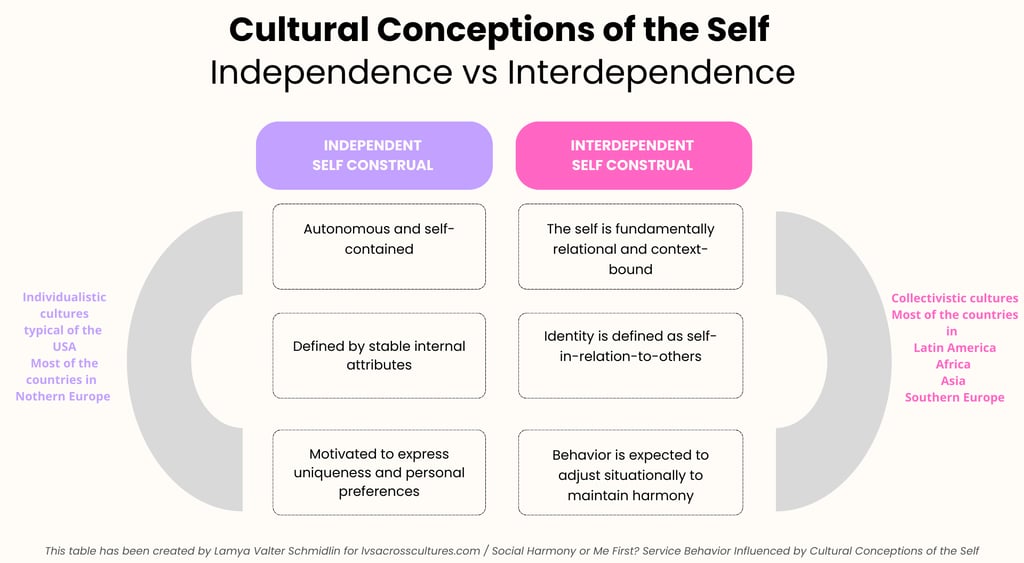
Markus and Kitayama argue that people in different cultures construct fundamentally different relationships between self and others, and that these constructions shape cognition, emotion, and motivation that reflects in their behavior. Building on de Mooij’s distinction between independent and interdependent selves, this figure below sums up the characteristics of each construal:
Markus and Kitayama further mention that emotion itself is culturally organized. In independent cultures, emotions are often treated as expressions of inner states. In interdependent cultures, emotional expressions are instrumental social acts, evaluated by their impact on harmony. This has clear implications for hospitality and service settings: open displays of anger or dissatisfaction may be avoided to preserve relational equilibrium. Negative feedback is often indirect or conveyed through contextual cues. Emotional restraint signals maturity and respect, not disengagement. So silence may indicate discomfort, not always satisfaction.
When KPIs meet culture: 3 stores, 3 realities
Psychological differences in self-construal and emotional expression directly shape how guest experience KPIs should be interpreted. Below is an example of how this could look like according to the cultural tendencies in 3 different environments.
-> In Miami (local independent self, with Hispanic/Latino influence)
In this context, local talents & consumers are relatively independent but influenced by social scripts like simpatía, which emphasizes warmth, harmony, and positive relational interactions. Traditional KPIs (NPS, conversion, and explicit feedback) are informative, but must be read carefully:
Typical service behaviors
Front line teams engage in small talk and informal rapport before moving to product or service needs.
Guests are encouraged to verbalize preferences and opinions, often through open-ended questions.
Emotional expressiveness — including mild dissatisfaction — is relatively acceptable and can strengthen the relationship when handled well.
How KPIs could be interpreted:
High NPS correlates with verbalized interactions
Conversion improves when teams encourage guests to articulate preferences
Explicit complaints help drive service improvements
Silence may not always indicate satisfaction, because some guests avoid complaints to preserve harmony. Staff training should include noticing subtle cues and reading relational context
-> In Amsterdam (local highly independent, direct self-construal)
In this context, local talents & consumers experience is shaped by individualism, autonomy, and highly directness in communication. Silence or low engagement generally reflects genuine satisfaction or disengagement, not indirect politeness:
Typical service behaviors
Front line teams provide clear information quickly and avoid unnecessary relational framing
Guests state preferences, dissatisfaction, or constraints explicitly and expect straightforward responses
Emotional restraint reflects efficiency and respect for boundaries
How KPIs coudl be interpreted:
Low complaints usually mean low dissatisfaction.
Direct feedback (positive or negative) is reliable for guiding performance improvement.
Conversion and repeat visits align closely with expressed preferences.
Emotional expression is consistent with inner states; negative feedback signals a real service gap. In-store talents are expected to respond directly and efficiently to complaints or suggestions.
-> Singapore (local interdependent self, culturally diverse and relationally attuned)
Here, talents & consumers experience is deeply shaped by relational harmony and interdependence:
Typical service behaviors:
Front line teams monitor nonverbal cues, pacing, and situational context rather than waiting for explicit requests
Guests may signal discomfort through reduced engagement, shorter visits, or non-confrontational behavior rather than direct complaints
Effective service involves subtle adjustments as timing, tone, level of assistance without drawing attention to the adaptation itself
How KPIs could be interpreted:
A stable NPS may mask declining loyalty if relational cues are missed
Few complaints may hide latent dissatisfaction, as guests avoid disrupting harmony
More indirect indicators become critical: visit frequency, guest relationship duration, talent adaptability, and team stability
Success requires anticipating needs, subtle relational cues, and proactive service adjustments without explicit request
KPIs are not culturally neutral. What looks like success in one market can hide dissatisfaction in another. Understanding local self-construals: independent vs. interdependent, and how emotions are expressed or restrained allows managers to interpret data accurately and design culturally attuned guest experiences.
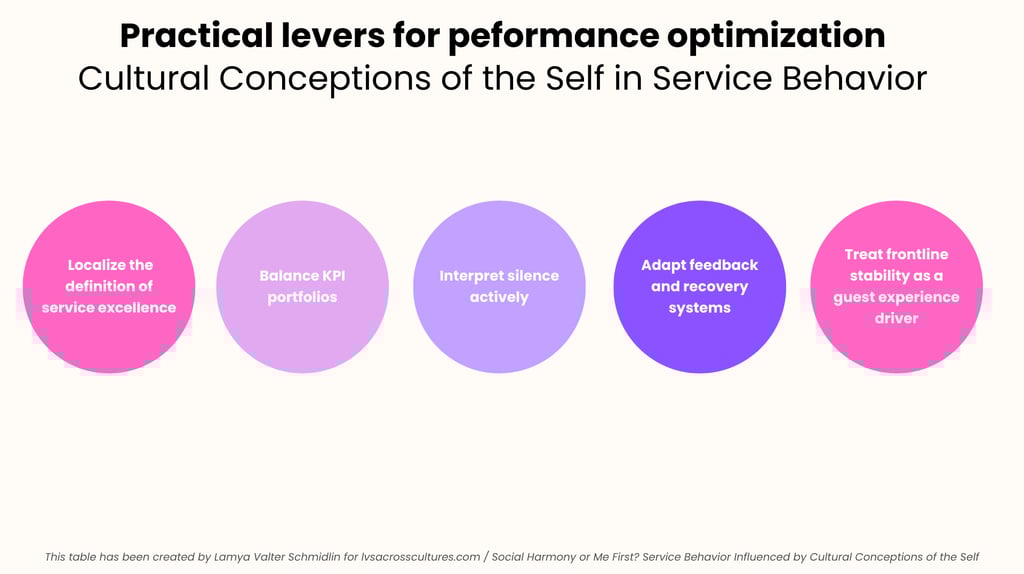
Practical levers for performance optimization
For GMs and retail directors, this understanding translates into several actions:
Amae: the emotional core of collectivist hospitality
The Japanese concept of amae offers a particularly powerful illustration of how interdependent selves shape hospitality at an emotional level. Amae refers to:
The expectation of being indulgently cared for
A feeling of emotional safety that allows one to depend on another
A relational state modeled on the mother–child bond
Experiencing amae means feeling free to relax one’s vigilance and self-control, trusting that the other will respond with care. Amae is like a relational signal. When amae is accepted, the relationship is confirmed; when it is rejected, the relationship is threatened.
Hospitality implication:
In collectivistic contexts, the perceived concept of hospitality does not merely meet functional needs but creates conditions in which guests can safely depend on the host. Anticipation, indulgence, and emotional attunement are therefore not excessive; they are culturally appropriate confirmations of relationship.
This also explains why:
Guests may expect hosts to notice needs without being told
Explicit requests may feel awkward or relationally disruptive
Warmth can coexist with hierarchy rather than equality


As Markus and Kitayama note, in interdependent cultures, actions are understood as situationally embedded, and moral evaluation focuses less on internal consistency and more on relational appropriateness. One direct consequence of interdependent self-construals is a different understanding of pro-social behavior.
This helps explain why hospitality in collectivistic societies is frequently:
More attentive, immersive, and emotionally involving
Guided by unspoken expectations rather than explicit requests
Experienced as an obligation tied to relationship and role rather than personal preference
Triandis’ concept of simpatía among Hispanic and Latin American cultures illustrates this clearly: harmony, warmth, and positive emotional display are culturally scripted expectations. When outsiders ignore these expectations, interactions can generate discomfort or perceived coldness, even when intentions are neutral.
Leading in-house experiences beyond universals
Differences in hospitality or retail experiences across cultures do not only stem from better or worse service philosophies, but from distinct self-systems that shape how people experience care, dependence, emotion, and social obligation. What feels attentive, respectful, or even generous in one context may feel intrusive or insufficient in another, not because standards differ, but because the underlying expectations of relationship differ.
In more individualistic service environments, guests often seem to respond positively to efficiency, clarity of choice, personal control, and respect for privacy. In more collectivistic environments, positive experiences more often emerge from emotional attunement, the anticipation of needs, visible reciprocity, and the careful preservation of harmony and face. Concepts such as amae, simpatía, or Ubuntu help illustrate that hospitality in these contexts is not simply “warmer,” but more relationally structured, emotionally embedded, and socially meaningful.
For global leaders, GMs or retail managers, the challenge is not to define a universal model of excellence, nor to standardize experience across markets but remining attentive to how hospitality is locally understood and felt. This, to help aligning operations, data interpretation, and management practices with the local psychology of the self that gives those experiences meaning.
The articles/books I've read to write this article:
Nisbett, R. E. (2019). The geography of thought: How Asians and Westerners think differently… and why (Updated ed.). Nicholas Brealey Publishing.
Markus, H. R., & Kitayama, S. (1991). Culture and the self: Implications for cognition, emotion, and motivation. Psychological Review, 98(2), 224–253.
De Mooij, M. (2019). Global Marketing and Advertising: Understanding Cultural Paradoxes (5th ed.). SAGE Publications.
For more insights, example of concrete actions to take and talk about this topic, feel free to contact me at lamya@lvsacrosscultures.com or connect with me on LinkedIn here!
Thank you for reading,
Lamya
*Featured picture: Édition Privée flagship Buenos Aires, Argentina - captured by Lamya Valter Schmidlin
LVS *AC
Cross-cultural Guest Experience Research & Consulting
contact
lamya@lvsacrosscultures.com
© 2026. LVS AC - All rights reserved.