The Complexity of Hospitality Rebranding: Aligning Talent with Shifting Brand Values
This article explores the critical role of values in hotel rebranding, showing how alignment between brand DNA, guest expectations, and employee behavior drives authentic experiences and measurable results. Rebranding creates HR complexities: employees must adapt to a new brand while maintaining service excellence. Success requires close collaboration between marketing, which defines the brand promise, and HR, which ensures talent alignment. Drawing on David Allison’s valuegraphics framework, the article shows how misalignment leads to disengagement, inconsistent service, and turnover, while alignment turns employees into natural brand ambassadors. It also provides a practical HR toolbox (below!).
HUMAN RESSOURCESHOSPITALITYGUEST EXPERIENCECROSS-CULTURAL MANAGEMENT
Lamya Valter Schmidlin
11/23/20255 min read
When an owner decides to convert an existing hotel into a new brand, especially one with a strong lifestyle identity or a branded residence concept, the rebranding process starts with location fitting and consumer-facing elements. Marketing teams meticulously design new touchpoints, refine the visual language, and define the future guest persona. Behind the scenes, one of the most critical success factors often receives less attention: the talent experience. Lifestyle brands cannot exist without people who embody them, and rebranding places pressure on both current and incoming employees. Values become the bridge or the fracture between brand DNA and talent DNA.This is where a strategy built on valuegraphics can provide clarity.
From Guest Behavior to Talent Behavior: Why Values Matter
David Allison’s research highlights a simple but transformative truth:
values are the only real driver of human behavior.
Demographics tell us who someone is. Psychographics tell us what they did before. But neither explains why they act the way they do. People make choices whether as consumers or employees based on what they value.
Valuegraphics were originally designed to understand consumer behavior, yet I found the logic applying seamlessly to talent experience too. Just as guests are drawn to brands that express their personal values, employees gravitate toward workplaces that align with what matters most to them. This becomes especially critical during rebranding, when the brand’s value system shifts. The alignment or misalignment between the new brand DNA and the values of the people delivering it determines whether the transition blooms or fractures.
Example:
A guest who values health & wellbeing chooses hotels with calm spaces, balanced experiences, and mindful design. An employee driven by that same value thrives in respectful, serene work environments. In a wellness-oriented rebrand, they become a natural culture carrier. In a nightlife-driven concept, they may disengage not due to skills, but because the environment contradicts what they value.
This is the power of values: They shape the experience guests seek and the behavior employees bring, making values alignment the foundation of any authentic, successful rebranding.
But what do we concretely mean by values? The researches of Allison highlight a list of 56 values identified in order of importance for the world, some examples of them are : Family who ranks 1st, Relationship as 2nd and other (at random) as Financial Security, Belonging, Personal Growth, Harmony, Morality, etc. Tests are used by psychologists to help people undrstand their value and make sure their life is aligned with those in order to ensure a certain peace of mind.
Why Rebranding Creates Talent Tension?
Rebranding shifts expectations, tone, and culture. In lifestyle hospitality, where identity is the product, this shift requires more than new uniforms or redesigned public spaces but it requires a different kind of behavior. HR profesionnal typically faces two parallel challenges:
1. Ensuring current talent can authentically deliver the new brand
Some employees align naturally with the new values. Others struggle, not because they lack capability, but because the brand now demands behaviors that contradict what motivates them.
2. Attracting incoming talent who reinforce the brand rather than dilute it
Recruiting on experience alone misses the engine of behavior: values. Without a values lens, teams become culturally fragmented, and the brand’s personality loses coherence.
And then a cascade of unwanted results can also show up such as a difficult talent experience for the new comers if the former talents already onsite create a negative atmosphere around this rebranding. Some tools can help.
Using Valuegraphics Archetypes in HR Strategy
The valuegraphic model identifies 15 universal archetypes or groups of people "tribes" driven by similar core values. For HR leaders navigating rebranding, these archetypes help:
Clarify the values embedded in the new brand DNA with the marketing teams
Map the values that currently drive the team
Predict alignment, resistance, and tension points
Shape EVP, communication, and development programs for maximum impact
The examples below illustrate how values translate directly into hospitality.
Concrete Examples Showing Impact on Performance and Results
Example 1 — Guest Engagement in Branded Residences
Focus: Wellness, Care & Long-Term Relationships
Scenario
A hotel transitions into a branded residence model, where success depends on familiarity, emotional consistency, care, and wellness-focused interactions.
New brand values: Care - Responsibility - Wellness - Consistency
Aligned archetypes: Responsibility - Wellbeing - Stability
Misalignment Scenario — Front Desk Example
A front desk associate motivated by material success and quick advancement
This associate prefers fast-paced hotel environments with high guest turnover, tips, visibility, and opportunities for rapid promotion.
In a branded residence, the rhythm is slower and emotionally consistent. Residents expect meaningful, wellness-oriented interactions, not transactional ones.
Misaligned Behaviors
They don’t take the time to understand residents’ routines or personal needs
When asked for suggestions (gyms, healthy cafés, quiet spaces), they recommend generic or trendy spots, not aligned with the residence’s wellness identity
Interactions feel rushed, surface-level, or scripted
They focus on tasks with visible recognition, ignoring subtle resident cues
They appear impatient with repetitive requests from long-term residents
Impact
Residents feel the associate “doesn’t get them”
Trust and comfort decline
Complaints about lack of personalization increase
Emotional consistency disappears
Turnover rises because the employee quickly becomes disengaged
New hires who value wellness become confused: why does the front desk model something opposite to the brand’s promise?
Alignment Scenario — Front Desk Example
A front desk associate motivated by wellness and human connection
This associate naturally enjoys supporting others and providing steady routines.
They take genuine interest in residents’ lifestyles and well-being goals.
Aligned Behaviors
Learns residents’ preferences and anticipates their needs
Recommends local wellness-oriented spots: cozy cafés, walking trails, yoga studios, healthy meal options
Maintains warm, consistent daily check-ins
Creates small rituals that enhance stability and comfort
Impact
Residents feel known, supported, and emotionally safe
Engagement increases and renewal rates rise
Brand reputation strengthens (“it feels like home”)
The associate becomes a cultural anchor for the community
New hires see values modeled clearly and consistently
Example 2 — Shifting to a modern concept focused on a sustainability
Scenario:
The new brand identity centers on local partnerships and sustainability.
New brand values: authenticity, locality, sustainability
Aligned archetypes: Environmentalism, Tradition, Trust
Performance Outcomes:
Misalignement
Operational decision: Buying generic amenities to save costs. A supervisor focused solely on efficiency orders generic, mass-produced amenities because they are cheaper and quicker to procure.
Impact on Brand, Culture & Performance
Guests perceive the sustainability message as “greenwashing"
Audit scores fall due to poor brand consistency
Community impact is lost, no support for local suppliers
New hires who joined because of the sustainability-driven rebrand feel confused and discouraged:
-> They don’t understand why leadership contradicts the brand promise
-> They begin doubting the company’s authenticity and their own fit
-> Early cultural engagement weakens
Bottom line:
A small cost-saving decision creates a brand contradiction and a cultural disconnect, especially for newcomers hired for their environmental values.
Alignement
Operational decision: Sourcing from local, sustainable partners. A supervisor motivated by environmental values collaborates with local artisans to create signature in-room products that reflect the region and the brand’s sustainability commitments.
Impact on Brand, Culture & Performance
Guests photograph, share, and talk about the amenities -> organic visibility
Retail revenue increases as guests purchase the products
Strong and meaningful community partnerships develop
The brand’s sustainability positioning becomes authentic
New hires feel aligned and inspired, seeing leadership model the values they were hired for
Bottom line:
Operational choices strengthen both the brand experience and the internal culture, making the rebrand credible and living.
Some other examples could be the shift from a taditionnal hotel that focused on legacy, heritage luxury to a lifestyle concept turned toward creativity and more lay off, where the talents from the previous team were used to greet every gust by their last name using title like Sir/Madam where the new targeted guest expect them to call them by their first name and recommend the ultimate trendy super-instagrammable spots in the city.
Why Values Drive Sustainable Talent Ecosystems
“Humans are magnetically drawn toward the things they value because what we value determines what we do.” During hotel rebranding, aligning EVP and talent strategy with valuegraphics reduce friction and helps in culture embodiement.
With values alignment:
Employees deliver the brand effortlessly
Guests feel authenticity rather than scripted hospitality
Recruitment becomes more targeted
Retention strengthens through meaning and fit
Performance grows through behavior that feels natural.
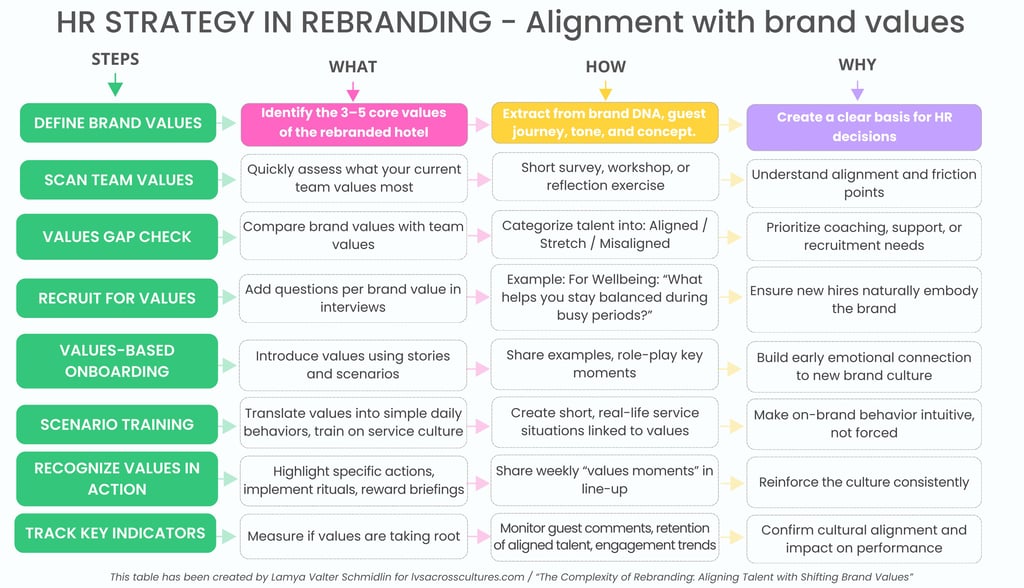
Below is a table I have created that can help developing a HR brand matching value-based strategy for rebranding.
The articles/books I've read to write this article:
Allison, D. (2022). The death of demographics: Valuegraphic marketing for a values-driven world. Nicholas Brealey Publishing.
Hein, A. Z., Elving, W. J. L., Koster, S., & Edzes, A. (2025). One size fits all? Employer branding in different contexts, Corporate Reputation Review
For more insights and talk about this topic, feel free to contact me at lamya@lvsacrosscultures.com or connect with me on LinkedIn here!
Thank you for reading,
Lamya
LVS *AC
Cross-cultural Guest Experience Research & Consulting
contact
lamya@lvsacrosscultures.com
© 2026. LVS AC - All rights reserved.