
Beyond Dutch Directness: Cultural Logics of Communication at Work
Drawing on experiences across the Benelux region and research in cross-cultural communication, this article explores how different professional environments navigate directness, relationality, context and meaning. A reflection on the often invisible assumptions shaping collaboration inside international organizations. Happy reading!
TALENT EXPERIENCE
Lamya Valter Schmidlin
5/31/20267 min read
After returning from the Netherlands, one impression remained with me more strongly than expected. Not simply the often-mentioned Dutch directness, but something more subtle: a different understanding of what professional communication is supposed to accomplish. Working across the Benelux region only sharpened this observation, as French-speaking Belgium often appeared closer to France in its communication dynamics and relational expectations than to its northern neighbour.
It naturally rises questions as What counts as clarity? What role should emotions play in professional interactions? Is relationship-building part of doing business, or something adjacent to it?
These differences matter far beyond anecdotal cultural observations. In multicultural organizations, they shape employee experience, leadership perceptions, negotiations, customer relationships and everyday collaboration. What one culture experiences as efficient and transparent may be perceived elsewhere as abrupt, impersonal or even relationally risky. Conversely, what one side considers diplomatic, nuanced or respectful can be interpreted by another as vague, inefficient or lacking ownership.
Research in cross-cultural communication suggests that many misunderstandings emerge because people communicate according to different cultural logics without being conscious of different schemas. This also comes from to which extent socio-emtional concerns are expected in work environments. This article explore this in details through the 3 "chapters" below. You will also find a visual mind gathering the interpersonal communication styles, at the end :).
Is work primarily about the task or also about the relationship?
One useful concept to look at here is "relational concern": the degree to which people attend to communication cues that preserve interpersonal harmony, social face and relationship quality in everyday interaction (Earley, 1997; Holtgraves, 1997; Ting-Toomey et al., 1991). When delivering criticism, declining a proposal or addressing disagreement, relational concern influences not only what people say but how they say it.
In "Conversing Across Cultures: East–West Communication Styles in Work and Nonwork Contexts" the authors took example of imagining presenting a project proposal and receiving the following feedback:
“The logic needs tightening and the methodology is problematic. But otherwise, you have some interesting ideas.”
Depending on one’s communication schema, the word interesting may be heard in very different ways. In some contexts, “interesting” functions as indirect criticism, a relational strategy that softens negative evaluation and protects both parties’ public image, what Goffman (1967) and Brown & Levinson (1987) would describe as “face.” A listener accustomed to reading indirect cues may immediately understand the underlying message: the proposal is not convincing. In other communication cultures, however, the expectation is different. Words are expected to correspond more closely to intended meaning. “Interesting” may simply be interpreted literally.
Research on Protestant Relational Ideology (PRI) developed by Sanchez-Burks and colleagues offers an important perspective here. PRI refers to a historically rooted belief, strongly associated with Protestant and particularly Calvinist, traditions that relational and socio-emotional concerns should be relatively limited in professional environments. This distinction between work and relational life has deep historical roots. Weber described how early Protestant ethics framed work as a calling, encouraging discipline, restraint and an “unsentimental impersonality” in work conduct. As Hampden-Turner and Trompenaars later summarized: “No intimacy, affection, brotherhood, or rootedness is supposed to sully the world of work.” Of course, contemporary workplaces are far removed from seventeenth-century theology. Yet cultural inheritances often persist after becoming secularized. PRI research suggests that in cultures more strongly influenced by these traditions, people may attend less to relational cues at work than in social settings.
This framing can illuminate some Northern European and Anglo work environments where professionalism is frequently associated with emotional restraint, role clarity, efficiency and task orientation. From a Latin perspective, the contrast can be striking. In Argentina, Spain or Italy, socio-emotional dimensions of work often remain more visible inside professional life. Relational warmth, personal rapport, conversational texture or informal exchanges are not necessarily viewed as distractions from efficiency. They may be part of how trust, coordination and long-term collaboration are built. Research on Latin work cultures points toward similar dynamics. Scholars describe traditions such as simpatía, a relational style emphasizing harmony, personal charm, graciousness and social connection, including within professional settings (Triandis et al., 1984; Diaz-Guerrero, 1967).
This does not mean that one model values relationships and the other values performance. Rather, the relationship between performance and relationality is conceptualized differently. For some professional cultures, maintaining a strong task focus is itself a way of demonstrating respect, competence and commitment. For others, effective work and relational attentiveness are not competing priorities but intertwined dimensions of professional credibility.
This distinction becomes particularly visible in multicultural business interactions. What is often presented as a “neutral” approach to business -> focusing exclusively on objectives, data and execution while putting aside interpersonal considerations, may in fact reflect a culturally specific understanding of professionalism rather than a universal one.
Directness, indirectness, and reading meaning
Many international communication misunderstandings are described through the familiar opposition between direct and indirect communication. Yet the distinction deserves a more nuanced reading.
Indirectness, as described by Grice, occurs when there is a gap between sentence meaning and speaker meaning, between what is literally said and what the speaker intends to convey.
Indirectness is not limited to wording. It can be communicated through nonverbal behaviour, vocal tone, pauses, understatement, faint praise or contextual signals (Ambady et al., 1996). Importantly, indirectness is not necessarily avoidance, manipulation or lack of transparency. In many cultural settings, indirectness functions as relational intelligence. Hall’s work on high- and low-context communication provides a useful lens. Low-context cultures tend to rely more heavily on explicit verbal information. High-context cultures distribute meaning across a wider ecosystem of cues: tone, hierarchy, shared assumptions, social context, timing and implicit understanding.
Marlieke de Mooij’s work further enriches this perspective by distinguishing between different interpersonal communication styles. Some cultures operate through a more verbal personal style: direct, explicit, person-oriented and relatively individual-centred. Others rely more on verbal contextual styles, where communication is more role-centred, situational and embedded in status or relational context.
The most consequential difference may not simply be directness itself, but who is considered responsible for effective communication.
In many Western low-context environments, responsibility tends to rest primarily with the sender. The communicator is expected to express intentions clearly, explicitly and unambiguously. In more contextual communication systems, particularly visible in parts of East Asia, effective communication also depends on the receiver’s capacity to interpret subtle cues, context and relational dynamics. Communication can involve a degree of “understanding without words.”
Neither model is inherently superior. But they create very different expectations. For professionals accustomed to explicit communication, high-context messages may appear frustratingly opaque. For communicators trained to navigate nuanced contextual meaning, highly direct messages may feel unnecessarily blunt, socially tone-deaf or even disrespectful.
These researchers highlighted that globalization has not eliminated these differences. If anything, multicultural workplaces may intensify them because business environments frequently activate different cultural schemas regarding what appropriate workplace communication should look like.
Still reading? Great, thank you! Because there are some interesting things coming!
Elaborate, exacting, succinct: different ways of creating meaning
Communication differences are not only about how direct people are but how much is said, how it is structured and where meaning is expected to reside. Drawing on Gudykunst, Ting-Toomey and later synthesized by Marieke de Mooij, communication styles can be distinguished between elaborate, exacting and succinct modes. The exacting style, common in many low-context, individualistic cultures, aims to provide neither more nor less information than necessary. Precision, clarity and economy of language are valued. Communication tends to be explicit, verbal and data-oriented.
This style often resonates with Northern European and Anglo business environments. In the Netherlands, for example, one frequently encounters a communication ethos that privileges clarity, concise argumentation and relatively direct feedback. The underlying intention is not necessarily confrontation. Quite often, directness functions as a form of efficiency, transparency or even egalitarianism: saying clearly what one thinks can be interpreted as a way of respecting the other person as an equal interlocutor. Yet the same interaction can be experienced differently through another cultural lens.
In parts of Southern Europe or Latin America, communication may carry a richer socio-emotional "texture". Meaning is not always confined to the informational content of the message itself. Tone, timing, relational warmth, conversational rhythm or contextual framing can matter equally.
France occupies an interesting position here. French communication can be both highly explicit and highly contextual. One can encounter strong verbal argumentation alongside nuanced layers of implication, status awareness and interpretive subtlety. Communication is not always reducible to the binary of direct versus indirect.
De Mooij’s framework usefully reminds us that communication styles cluster along several dimensions simultaneously: directness, contextuality, explicitness, power distance and uncertainty avoidance all interact in shaping how meaning is produced and interpreted. I have created the map below from her research:
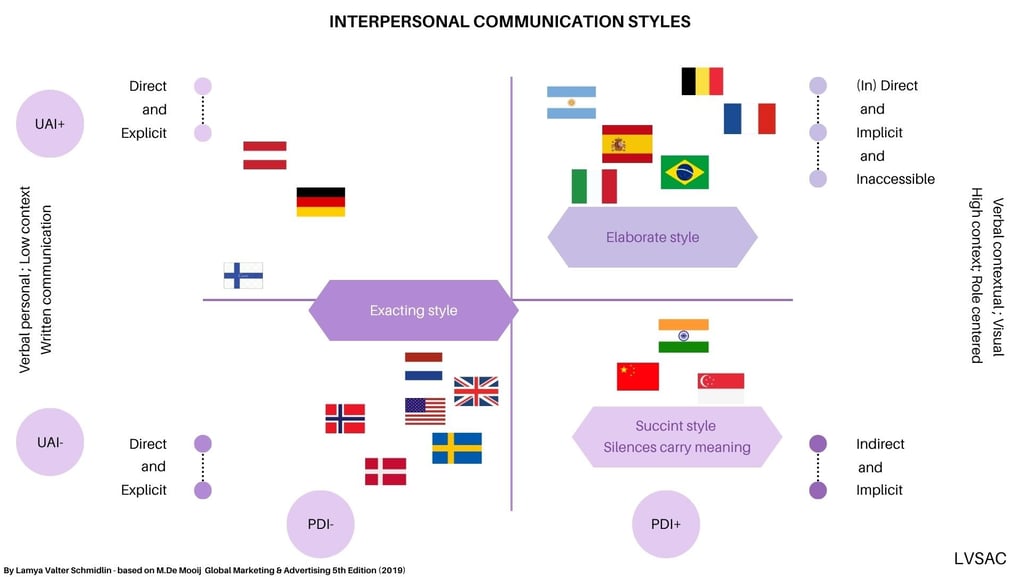
De Mooij explains that:
The exacting style is a style where no more or no less information than required is given, mostly found in individualistic cultures that have been literate for a long time.
The elaborate style, often associated with more collectivistic or higher uncertainty avoidance cultures, relies on richer expressive language, metaphor, adjectives, contextual framing and verbal ornamentation. M. De Mooij takes the example of the Arab cultures, where elaborate verbal expression carries relational and rhetorical significance. Communication does not only transmit information but also about create the social atmosphere and signalling engagement.
The succinct style, found particularly in several East Asian high-context cultures, follows a different logic altogether. Meaning may reside not in verbal abundance but in understatement, pauses, silences and shared contextual understanding. Silence itself can become communicative.
For professionals socialized in exacting communication systems, succinct communication can feel incomplete. For succinct communicators, exhaustive explicitness may appear unnecessarily literal or socially insensitive. Again, these are not merely stylistic preferences -> they reflect deeper assumptions about how social coordination works.
Reflexion
The comparison between the Netherlands, French-speaking Belgium and France illustrates this complexity particularly well. Geographic proximity and economic integration do not automatically produce shared communication norms. Even neighbouring societies may diverge in how they distribute meaning between words and context, task and relationship, explicitness and interpretation.
Rather than pointing toward a single model of “effective” professional communication, these patterns suggest that workplace interaction operates through multiple cultural logics coexisting inside global organizations. The practical challenge often lies less in communicating well in an abstract sense than in recognizing that colleagues, managers, clients or partners may be working from fundamentally different ideas of what good professional communication is supposed to accomplish.
To write this article, I have read:
Sanchez-Burks, J., Lee, F., Choi, I., Nisbett, R., Zhao, S. & Koo, J. (2003). “Conversing Across Cultures: East–West Communication Styles in Work and Nonwork Contexts.” Journal of Personality and Social Psychology, 85(2), pp. 363–372. https://doi.org/10.1037/0022-3514.85.2.363
de Mooij, M. (2010). Global marketing and advertising: Understanding cultural paradoxes (3rd ed.). SAGE Publications.
Sanchez-Burks, J., Nisbett, R. E. & Ybarra, O. (2000). “Cultural Styles, Relational Schemas, and Prejudice Against Out-Groups.” Journal of Personality and Social Psychology, 79(2), pp. 174–189. https://doi.org/10.1037/0022-3514.79.2.174
The 6-D model of national culture - geerthofstede.com
In “Conversing Across Cultures: East–West Communication Styles in Work and Nonwork Contexts.” -> Grice, H. P. (1968). Utterer’s meaning, sentence-meaning and word mean-
ing. Foundations of Language, 4, 225–242.
Hall, E. (1983). The dance of life. New York: Anchor Press.
For more insights, example of concrete actions to take and talk about this topic, feel free to contact me at lamya@lvsacrosscultures.com or connect with me on LinkedIn here!
Thank you for reading,
Lamya
LVS *AC
Cross-cultural Guest Experience Research & Consulting
contact
lamya@lvsacrosscultures.com
© 2026. LVS AC - All rights reserved.