
Defining vs Delivering the Brand: A Cultural Perspective on Personality - L&D
This article explores how brand personality frameworks, so natural in the West, don’t always translate globally. Through research and examples, it uncovers how meaning and interpretation shifts across cultural contexts. It helps understanding the hidden gap between brand intent and customer experience in international markets while showing how a cross-cultural conscious L&D strategy is crucial for a relevant local brand experience. Happy reading!
EXPERIENTIAL MARKETINGGUEST EXPERIENCERETAILCROSS-CULTURAL MANAGEMENTTALENT EXPERIENCE
Lamya Valter Schmidlin
3/29/20265 min read
Let’s start this article with a test.
You have 30 seconds to choose a brand.
Do you have it?
Now, think about the attributes of this brand, not the product itself. It can be the atmosphere, or a moment you experienced that it recalls.
Which words would you use to describe a trait of this brand, something that could even reflect part of your own personality?
Are you able to associate personality traits with this brand?
These could be broad dimensions such as sophistication, sincerity, excitement, ruggedness, or competence. Or more precise traits like glamorous/charming, down-to-earth/wholesome, daring/cool, outdoorsy/tough, or reliable/confident.
Think about how much these traits are connected to you and if you would use it to describe this brand in any context.
If this exercise felt easy, research suggest that you are likely from a Western cultural background, or at least familiar with Western brand strategies that rely on personality frameworks.
If you found it difficult to assign personality traits to a brand out of context, research would suggest you may come from a more collectivist culture, such as in East Asia, where the concept of personality, especially defined abstractly, is less commonly used in this way.
Welcome!
In this article, I explore how brand personality operates across cultures and how this connects to L&D strategies for brands expanding from West to East.
This is about insights, examples, and recommendations.
What the researchers say - the insights
The broad dimensions and personal traits given as example in the test (sophistcation, sincerity, excitement, ruggedness, or competence and more precise traits like glamorous/charming, down-to-earth/wholesome, daring/cool, outdoorsy/tough, or reliable/confident) are the result of J. Aaker framework on brand personnality.
In her research, Jennifer Aaker raises a fundamental question -> do brands have a framework of personality dimensions similar to or different from the “Big Five” dimensions of human personality?
Her objective was to build a theoretical framework of brand personality dimensions and develop a reliable, valid, and generalizable scale to measure them. She defined brand personality as: “the set of human characteristics associated with a brand.”
Brand personality plays a key role in creating strong, favorable, and unique associations in consumer memory, ultimately strengthening brand equity (Keller, 1993; Johnson et al., 2000; Phau and Lau, 2000). It is therefore considered a critical driver of brand success, particularly in influencing preference and choice (Batra et al., 1993; Biel, 1993).
In contrast to product-related attributes, which serve a functional or utilitarian purpose, brand personality serves a symbolic and self-expressive function (Keller, 1993).

Some examples
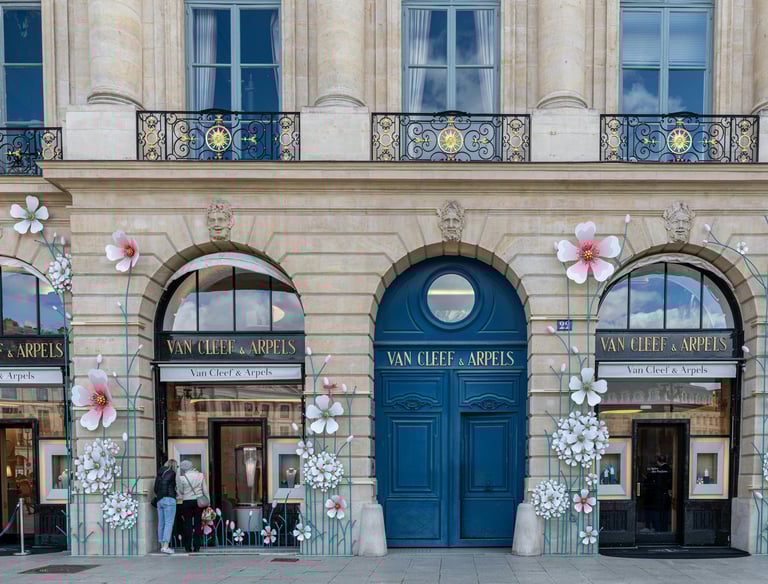
The following examples come from two brands that I admire, as I am particularly fascinated by the distinctive brand atmospheres they create and how they draw in curious minds that resonate with their values and "personality".
If Van Cleef & Arpels was your neighbor, how would you imagine them?
A graceful, poetic individual in their late 30s, romantic, imaginative, and deeply attuned to beauty. Someone who finds meaning in symbolism, nature, and storytelling: a ballet lover, a collector of rare objects, someone who sees craftsmanship as a form of enchantment. Their style is delicate yet sophisticated, favoring fluidity, lightness, and intricate detail over overt display. Socially, they are charming and cultured, with a soft-spoken confidence less authoritative, yet deeply captivating through elegance and emotional resonance.
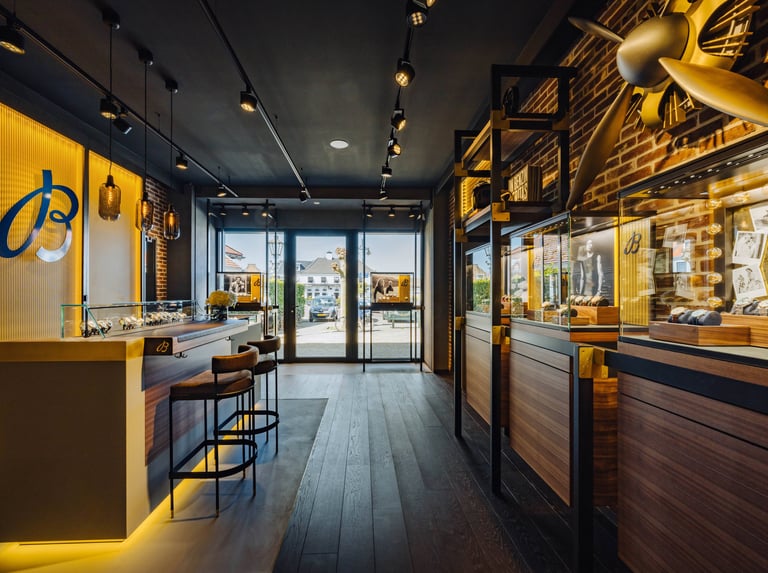
And next door is Breitling.
From my pov, Breitling personifies as a confident, action-oriented individual in their 40s to 50s, disciplined, adventurous, and technically driven. A pilot, engineer, or explorer: someone who values precision instruments and performance under pressure. Their style is bold and functional, rooted in aviation heritage and mechanical mastery. They thrive in high-stakes environments, enjoying speed, complexity, and control. Socially, they are direct, charismatic, and assertive, less about quiet refinement, more about capability, reliability, and presence.
However, J.Aaker’s research is based on a U.S. sample, and as she herself notes: “the current scale might not be appropriate for measuring brand personality in a different cultural context.” So then, how do marketers talk about the brand DNA when expanding in another environment?
Aren’t brand personality traits frameworks universal?
Research in cultural psychology suggests that the symbolic use of brands differs significantly across cultures (Aaker & Schmitt, 1997). At the core of Western based branding lies the concept of "self-brand congruity" -> the tendency for consumers to choose brands that align with their self-image, using them to express identity. This mechanism is far more prevalent in individualistic cultures, where self-consistency across contexts is valued (reading this article for more information about this topic can help).
In contrast, if we have a look at collectivistic culures patterns, Marieke de Mooij explains:
“If people are not used to describing themselves in abstract terms, out of context, they are not likely to be able to do so for brands either.”
In individualistic cultures, where independence, autonomy, and uniqueness are emphasized, consumers use brands to express how they are different from others. In collectivist cultures, where interdependence, harmony, and conformity are valued, consumers use brands to express how they are similar to their in-group (Markus & Kitayama, 1991).
Beyond individualism: cultural dimensions and brand perception
Beyond the individualism vs collectivism lens, other dimensions from the Hofstede 6D model also shape how brand personality is perceived.
As Plummer (2000) highlights, brand personality has two equally important sides:
Input -> what brand managers intend consumers to perceive
Output -> what consumers actually think and feel
These do not always align, especially across cultures and M. de Mooij also mentions it:
“Trustworthy” is often attributed to strong brands in high uncertainty avoidance cultures
“Prestigious” resonates in high power distance cultures
“Innovative” is valued in low power distance and low uncertainty avoidance environments
This is where the challenge and the opportunity begins for brands expanding, especially from West to East.
So then, what should we do with all of this?
If brand personality is not universally interpreted, if consumers do not relate to brands in the same way across cultures, and if meaning itself shifts depending on context, then one thing becomes clear:
Brand cannot be trained the same way everywhere.
For brands expanding from West to East, the challenge is not just adapting marketing or communication, it is also about translating the brand into behaviors that make sense locally L&D plays a critical role. Brand is not to sit in a brand book or only in the design, it is delivered daily by the frontline team.
If teams are trained using Western frameworks built on abstraction, personality traits, and self-expression, there is a real risk of misalignment: the brand is clearly defined at HQ // But inconsistently understood and therefore inconsistently delivered on the ground.
L&D becomes the bridge between:
What the brand intends (input) + What customers actually experience (output)
In other words, L&D is enabling cultural translation.
So instead of asking: “How do we teach our brand personality?” We can ask ourselves: “How do we translate our brand into behaviors, rituals, and experiences that are culturally relevant?”
From insight to action
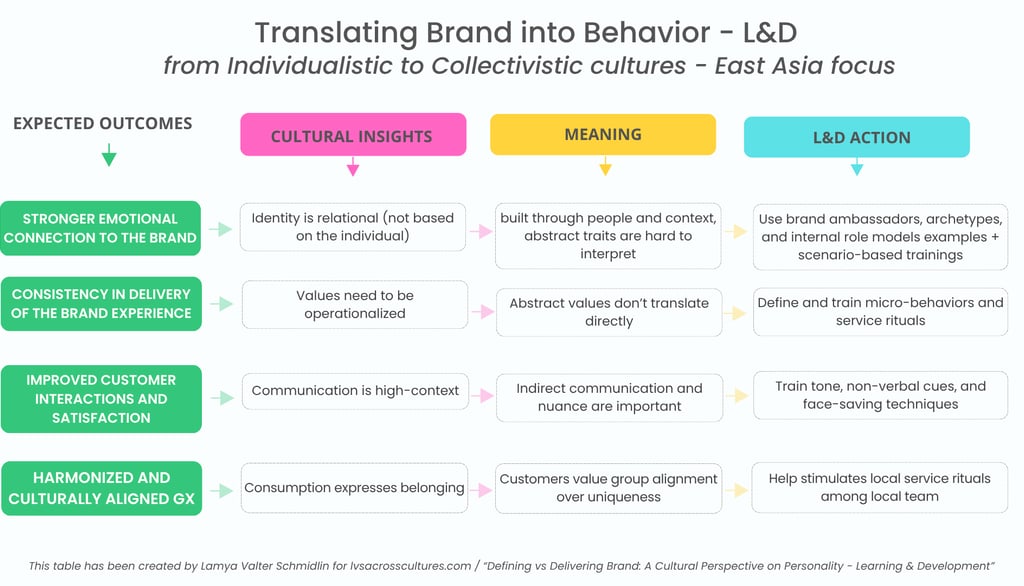
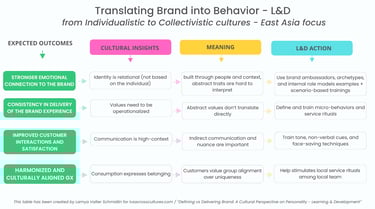
In the table below, I gathered practical L&D recommendations based on cultural insights for brands expanding into markets such as Japan or South Korea.
The following books and articles inspired me to write this article:
Nisbett, R. E. (2019). The geography of thought: How Asians and Westerners think differently… and why (Updated ed.). Nicholas Brealey Publishing.
De Mooij, M. (2019). Global Marketing and Advertising: Understanding Cultural Paradoxes (5th ed.). SAGE Publications
Aaker, J. L. (1997). Dimensions of brand personality. Journal of Marketing Research, 34(3), 347–356.
Markus, H. R., & Kitayama, S. (1991). Culture and the self: Implications for cognition, emotion, and motivation. Psychological Review, 98(2), 224–253.
For more insights, example of concrete actions to take and talk about this topic, feel free to contact me at lamya@lvsacrosscultures.com or connect with me on LinkedIn here!
Thank you for reading,
Lamya
LVS *AC
Cross-cultural Guest Experience Research & Consulting
contact
lamya@lvsacrosscultures.com
© 2026. LVS AC - All rights reserved.